



Introdução: Existe um elo indispensável na pesquisa médica, ou seja, os experimentos com animais. De acordo com estatísticas incompletas, milhões de animais em todo o mundo são vítimas de experimentos científicos todos os anos. Embora pareça sangrento, também é um processo pelo qual o desenvolvimento médico deve passar. No entanto, com o desenvolvimento da tecnologia de bioimpressão 3D nos últimos anos, espera-se que alguns construtos bioimpressos consigam a substituição funcional do tecido vivo e, gradualmente, atinjam o objetivo de substituir experimentos com animais.

△In 2014, about 400,000 mice died in the laboratory
18 de fevereiro de 2022 Um projeto financiado pela União Europeia (UE)-está procurando reduzir os testes em animais em pesquisas médicas experimentais por meio da bioimpressão 3D. Coordenado pelo Instituto de Bioengenharia da Catalunha (IBEC), o projeto BRIGHTER (Bioprinting by Photolithography: Complex Tissue Engineering at High Resolution and Speed) está desenvolvendo novas abordagens para processos de bioimpressão 3D de engenharia de tecidos e medicina regenerativa para reduzir o uso de taxidermia em estas áreas. De particular interesse, o projeto se concentra na fabricação de pele humana usando uma nova técnica de bioimpressão baseada em folhas de luz laser padronizadas.
Professor Elena Martinez, coordinator of the BRIGHTER project, said: "Our innovative 3D bioprinting system not only achieves tissue closer to the real thing, but is also much faster than current systems, an essential factor in ensuring the viability of new tissue."
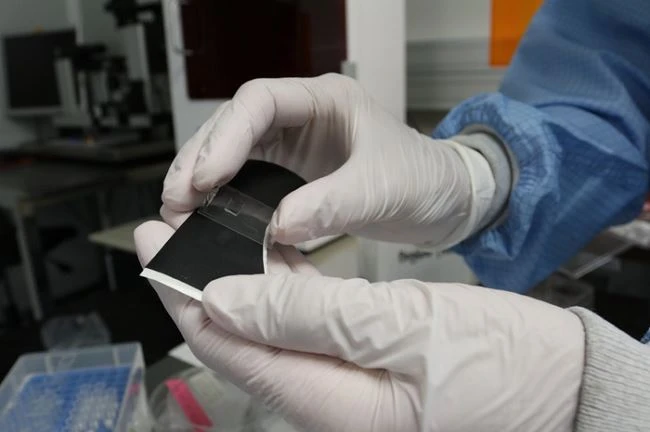
△ A small square containing a matrix of skin cells. Photo via IBEC.
Reduzindo testes em animais com impressão 3D
A tecnologia de bioimpressão 3D avançou aos trancos e barrancos na última década, com grandes avanços no desenvolvimento de tecidos viáveis para pacientes-específicos. Embora esses desenvolvimentos sejam promissores para futuros testes de eficácia, os tecidos ainda são amplamente experimentais e os testes de medicamentos em humanos estão a décadas de distância. No entanto, tanto a academia quanto a indústria estão trabalhando para mudar isso, com a fabricante sueca de bioimpressoras CELLINK prometendo avançar sua pesquisa em modelos de teste de células inofensivas em animais e usando modelos de pele em miniatura na Universidade de Stuttgart para testar a eficácia de medicamentos contra o câncer com o objetivo de eliminar testes em animais.
Elsewhere, Fluicell's Biopixlar platform has produced highly complex neural models that show potential for future clinical drug screening applications, while UpNano's NanoOne Bio system is focusing on the fabrication of cell culture microstructures that may have Helps reduce the number of animal experiments behind clinical trials.

△CELLINK has acquired in vitro technology specialist MatTek to create a harmless drug testing model. Photo via MatTek.
Uma alternativa mais humana aos testes em animais
In addition to IBEC, the Goethe University Frankfurt, the Technion Center in Israel and the biotechnology companies Mycronic and Cellendes are also participating in the BRIGHTER project. The program hopes to overcome many of the technical barriers that currently limit the fabrication of complex human tissue. The partners are collaborating on the development of a novel light-sheet bioprinting process capable of producing complex and accurate in vitro models that can be used for cosmetic and drug testing in the pharmaceutical industry and research settings. To fine-tune the technology, the BRIGHTER team is working to 3D print human skin, a highly complex tissue composed of multiple cell types and structures, such as sweat glands and hair follicles. Hydrogels will form a key component of the bioprinting process, as they form the basis for cells to grow and form new tissues, and they can also be personalized using a patient's own cells. To print skin with the desired structure, shape, and consistency, the researchers are using advanced imaging techniques that combine illumination from light sheets and high-resolution digital masks. By applying the laser directly to the hydrogel, the cells within it can be "patterned" and shaped into the right shape, allowing the team to control the stiffness, shape and size of the 3D printed structures.
The ability to shape hydrogels at a high level is especially critical for successfully printing human skin, because this tissue is made up of many layers of cells of different types. According to the BRIGHTER team, their bioprinting process was also able to create the blood vessels of the printed tissue and enable the function of sebaceous and sweat glands, as well as hair follicles to grow hair. Dr Nuria Torras, a postdoctoral researcher at IBEC, said: "We hope to be able to print a skin sample with an area of 1 square centimeter and a thickness of 1 mm in about 10 minutes with a cell viability rate of over 95 percent , greatly improving current bioprinting conditions. "The BRIGHTER project hopes that successful printing of the in vitro skin model will validate its potential for use in pharmaceutical and research settings, and ultimately reduce animal testing for drug and cosmetic testing.

A Guangmai Technology está profundamente envolvida em fontes de luz saudáveis e inteligentes, fornecendo uma gama completa de produtos e soluções UVA UVB UVC LED, infravermelho IR LED VCSEL para o mercado. Possui centenas de parceiros de alta-qualidade nos mercados interno e externo para promover em conjunto o uso da tecnologia leve para criar uma vida saudável e inteligente. .


